Hochstein observation tower in the Königshain Hills
The 22-metre observation tower stands right beside the Hochsteinbaude at 406 m – 101 steps lead up to the platform, and the climb is free. From the top, the view stretches across the Königshain Hills and Upper Lusatia as far as the Zittau Mountains.
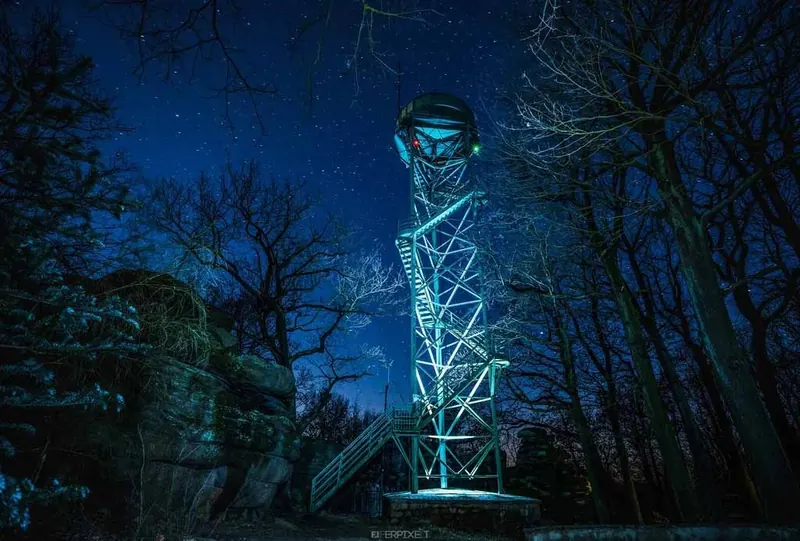
What can you see from the tower?
From the platform you look out over the countryside and the imposing granite rocks to the surrounding hills. The view is especially lovely in autumn, when the leaves change colour. For families, the granite rocks around the tower are an invitation to climb and explore.
Climbing the tower
The tower is open during the inn’s opening hours: Wednesday to Sunday, 11 am to 6 pm, in winter until 5 pm. The climb up the 101 steps is free. We are grateful for any donation towards the upkeep of the tower – the box is at the tower.
The Hochstein – the rock that gives the inn its name
The Hochstein (High Rock) is the second-highest point in the Königshain Hills. Its summit is formed by towers of Königshain granite, around 300 million years old and shaped by spheroidal weathering into the rounded, stacked blocks that people climb today. Unlike many rocks in the area, they were spared by the quarrying.
On 1 June 1844, King Frederick William IV of Prussia visited Königshain and the Hochstein. A memorial plaque set into the granite still recalls the visit – it was restored in 2022 by the Königshain local history society, the Königshainer Heimatverein, together with Erik Hamann. Fifty years after the royal visit, from 1895 to 1897, the Friedrich-Wilhelm-Baude was built – today’s Hochsteinbaude.
The European long-distance path E10 and the Way of St James cross the summit. Close by are the Totenstein, one of the oldest natural monuments in Germany, and the Teufelsstein with its legend: the Devil, enraged by the building of the church in Nieder Seifersdorf, tore his trousers while flying over the church tower and mended them up on the rock. The legend gives its name to the game played at our annual fair, the Hochsteinkirmes: “Der Teufel wirft den Stein” (The Devil Throws the Stone) – a contest in which heavy granite stones are thrown.
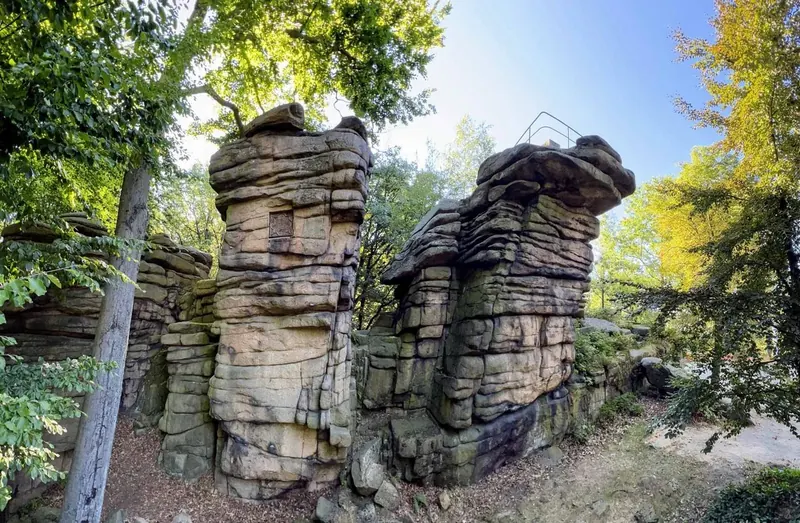

“Hier stand am 1. Juni 1844 der Koenig von Preussen Friedrich Wilhelm IV., der Freund und Beschuetzer vaterlaendischer Naturschoenheit.” (Here stood, on 1 June 1844, the King of Prussia, Frederick William IV, friend and protector of the natural beauty of the fatherland.)Cast-iron plaque set in the granite, restored in 2022 – right on the summit rock, a few steps from the tower.