The rock with the sun in its eye
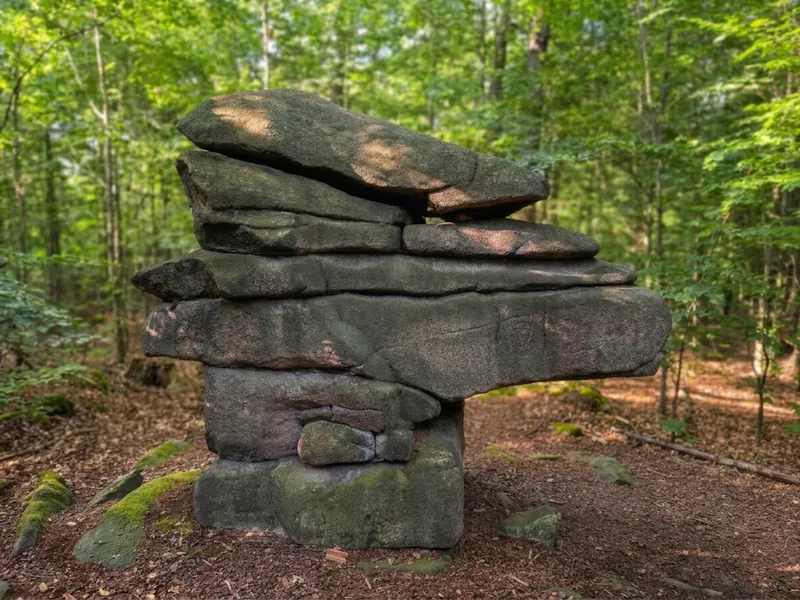
Three hundred metres north of the Hochstein stands a block of granite whose shape recalls a bird’s head – most people see an eagle. In that head there is an opening that looks like an eye. It came about by itself. And around the winter solstice, the midday sun stands exactly within it.
How the sun’s position shifts through the year
A gap that points to December
The opening was not chiselled; it broke. The top slab of the rock cracked, and the piece that came away slipped by a few centimetres. Between the two fractured faces a gap remained – and you can see straight through it.
For a long time nobody measured systematically where this gap points. Only in 2007 did Hilmar Hensel and Ralf Herold describe the alignment: it meets the midday sun at the winter solstice. On several days around 21 December the sun stands exactly in the opening at noon.
The interest was not new. As early as 1937 the Leipzig University Observatory examined the rock as a possible sun sanctuary. In 2008 the “Bruno H. Bürgel” public and school observatory in Sohland an der Spree founded an archaeoastronomy working group, which studies the Kuckuckstein and other rocks in Upper Lusatia.
So nobody made the gap. Whether people used it or revered it has not been proved. What is established is the alignment – and that chance here points to the shortest day of the year, of all days.
Granite, older than any story
The Kuckuckstein (Cuckoo Rock) is made of Königshain granite and belongs to the Görlitz massif, which extends beneath some 200 square kilometres of Upper Lusatia. The granite solidified deep in the earth around 320 million years ago; only weathering exposed it and shaped it into the rounded, stacked blocks that stand everywhere up here.
What stands out is the high proportion of potassium feldspar – it gives the stone the pale, almost reddish tone that you see on freshly broken surfaces.
How our rocky landscape came to be
Why do the slabs here lie one on top of another like stacked loaves, and why does the stone round off at the edges? Two films tell the early history of this landscape – they were not shot here, but it is the same rock and the same story.
How rock formations like these come about – shown by the example of the Felsenstadt Jonsdorf, the rock town of Jonsdorf.
How the hill that Görlitz calls its own came to be.
Both films: © Matthias Knappe, produced on behalf of the Senckenberg Gesellschaft für Naturforschung (Senckenberg Society for Nature Research).
The films are hosted on YouTube. A connection is only made when you click “Load film” – until then, nothing about you is transmitted.
On paper since 1780
A copper engraving by Carl Adolph Gottlob von Schachmann, lord of the manor of Königshain, shows the Kuckuckstein as early as 1780 – in exactly the form in which it stands today. In almost 250 years nothing about it has changed that the eye could see.
In 1828 Karl Benjamin Preusker supposed that neighbouring stones were pagan sacrificial altars of a sun cult. There is no proof of that. What there is, is a large number of archaeological finds from the Königshain Hills reaching back to the Stone Age: people were up here early on.
The cuckoo was the Devil
In older popular speech, “Kuckuck” (cuckoo) was a veiled word for the Devil – one did not call him by his name. Whoever christened the stone may therefore not have meant a bird at all.
The neighbourhood fits: a few hundred metres further on stands the Teufelsstein (Devil’s Rock), home of the legend that gave our Hochsteinkirmes, the annual fair, its name. And of the Kuckuckstein it is told that on St John’s Day the little earth-folk dance across the rocks.
As so often with old place names, none of this can be proved. It is a reading, not a record.
Ten minutes from our door
The Kuckuckstein lies on the footpath between the inn and the former Königshain station – the signpost on the ridge gives the distance as 400 metres. From the Hochstein the path heads north, gently downhill. If you are walking the first stage of the Way of St James, you pass it in any case.
Frequently asked questions
When exactly is the sun in the eye?
Around the winter solstice – that is, around 21 December – at midday. It can be seen on several days, not just one.
Can you see the hole at other times too?
Yes, the rock is freely accessible all year round and the opening can be made out at any time. It is just that at other times the sun is somewhere else.
Is the Kuckuckstein really a solar calendar?
What has been measured is the alignment with the midday sun at the winter solstice. But nobody made the gap: it came about when the capstone broke and the detached piece slipped. Whether people later made use of it has not been proved – there are no written sources.
Are you allowed to climb the rock?
Please don’t. The rocks of the Königshain Hills are fragile, and the Kuckuckstein is one of a kind. The eye is best seen from below anyway.
First the rock, then the inn
After the detour to the Kuckuckstein it is only a few minutes back to the inn. Hot food during opening hours, coffee and cake in the afternoon.