Carl Adolph von Schachmann
Anyone standing on the Hochstein today is standing in a landscape that was looked at very closely once before, some 250 years ago. Carl Adolph Gottlob von Schachmann (1725–1789), lord of the manor of Königshain, drew, examined and described these rocks – long before anyone used the word conservation. It is thanks to his eye that we know what the Kuckuckstein (Cuckoo Rock) looked like in 1780.
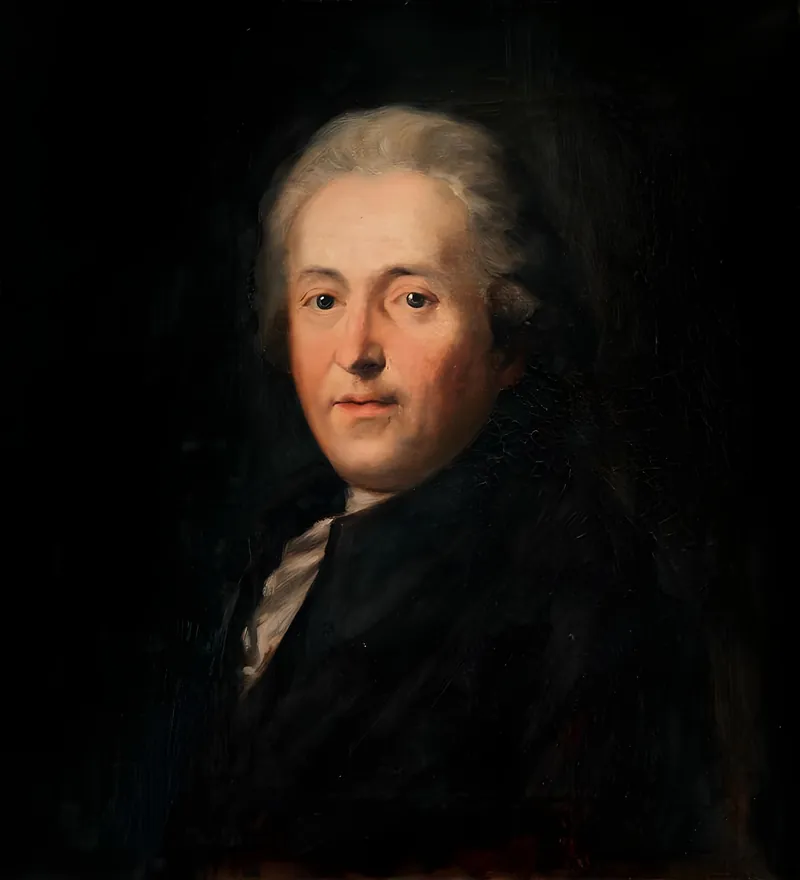
Why this is here
Strictly speaking, this page does not belong to an inn. But the Hochsteinbaude stands on the rock that Schachmann drew, and most of our guests walk past three of his subjects without knowing it. A few paragraphs of background turn the way up into a different walk.
A man of the Enlightenment in Upper Lusatia
Schachmann came from a family whose history reaches back to the days of the Hanseatic League. It came from Danzig and later put its money into Silesian estates. He was born in 1725 in Hermsdorf near Görlitz.
From 1743 to 1748 he studied in Leipzig and Halle: law, and alongside it philosophy and the arts. Then he spent two years on an educational tour through Germany, France and the Netherlands. Those who travelled in that way came home with questions.
In 1752 his father died and Schachmann took over the manor of Königshain. From then on his life is bound up with this village and these hills. In 1764 he joined the Moravian Church (Herrnhuter Brüdergemeine); in the same year the rebuilding of the manor house began, and between 1765 and 1770 he had a large landscape garden laid out around it.
In 1779 he was admitted to the Oberlausitzische Gesellschaft der Wissenschaften (Upper Lusatian Society of Sciences). In 1785 he withdrew to Herrnhut, where he died on 28 January 1789.
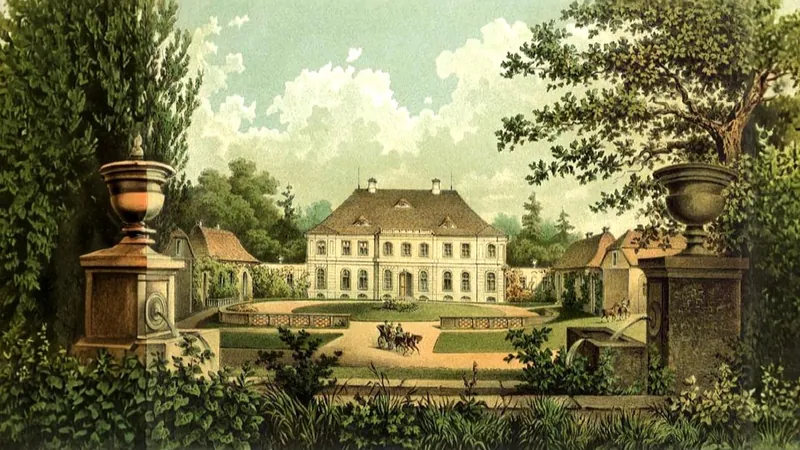
The first account of these hills
In 1780 the book appeared that makes Schachmann indispensable to our district: “Beobachtungen über das Gebirge bey Koenigshain in der Oberlausitz” (Observations on the hills near Königshain in Upper Lusatia). It sets side by side what hardly anyone at the time thought of together – the nature of the granite, the shape of the individual rocks, the finds in the ground and the stories told about them in the village.
At the Totenstein (Rock of the Dead) he found hundreds of pottery sherds and objects of bronze. He read the site not as a burial ground but as a place where people gathered to celebrate at certain times of the year. In 1844, 64 years after his account, King Frederick William IV placed the group of rocks under protection as a “Denkmal der Vorzeit” (monument of ancient times) – one of the oldest natural monuments in Germany.
He described the Kuckuckstein as a precisely aligned block. That the midday sun appears in its opening around the winter solstice was not measured until 2007, by Hilmar Hensel and Ralf Herold. But Schachmann’s engraving of 1780 already shows the rock in exactly the form in which it stands today.
What he saw, you can see for yourself
Schachmann drew with his own hand – pen drawings, etchings, hand-coloured sheets. This is not art for its own sake: the sheets record what a rock looks like, from which side and in what light. Take them with you on your walk and compare.
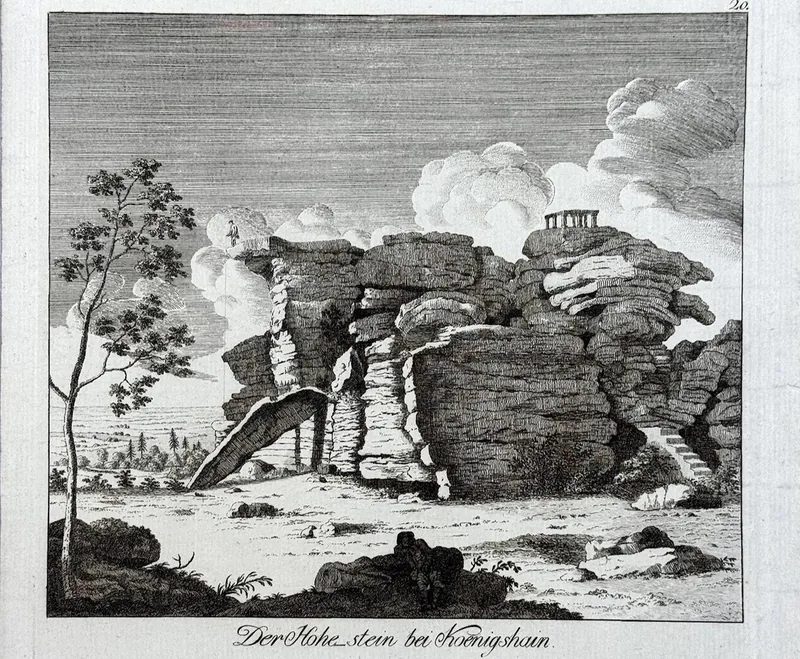
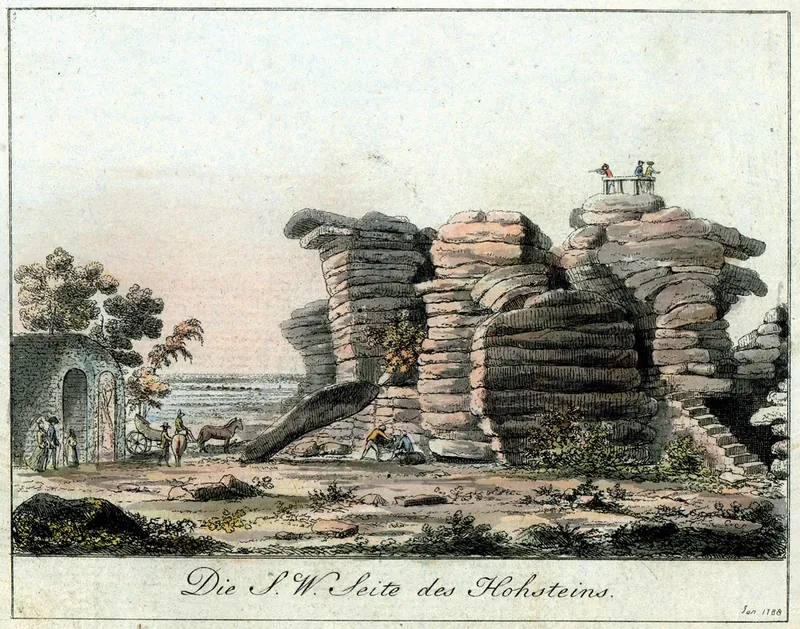
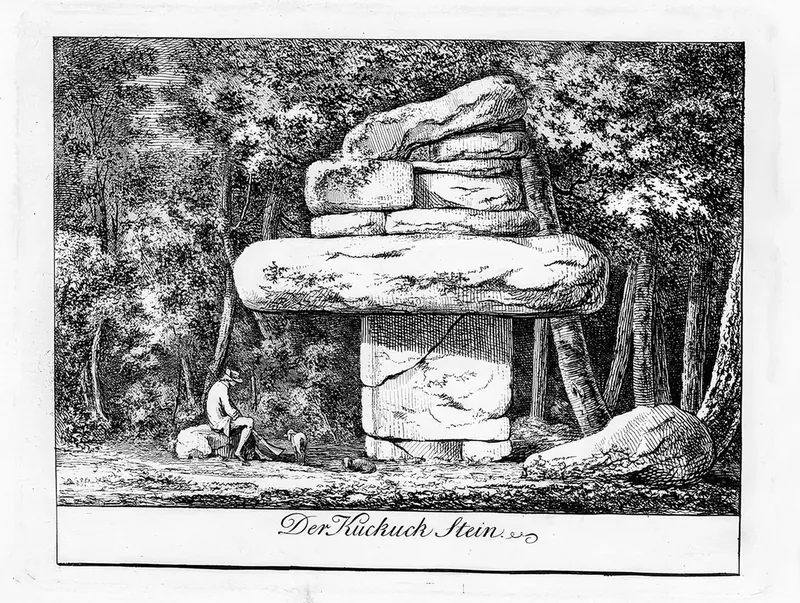
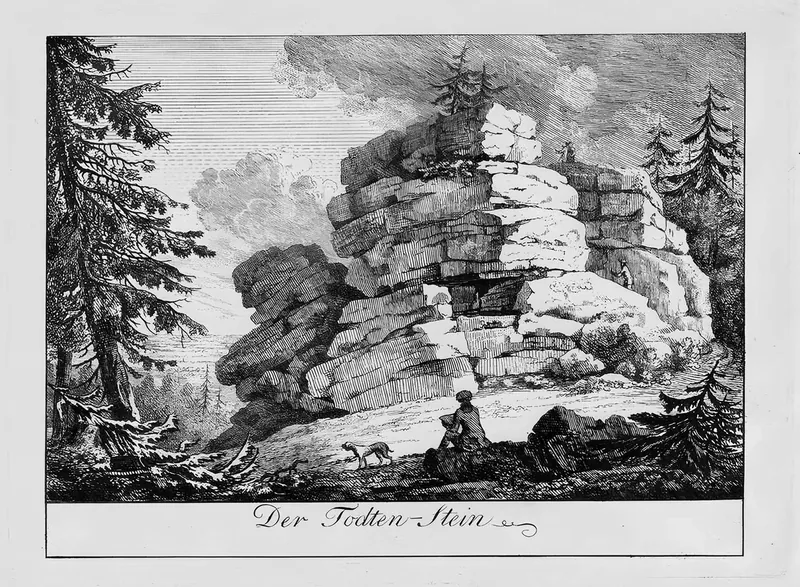
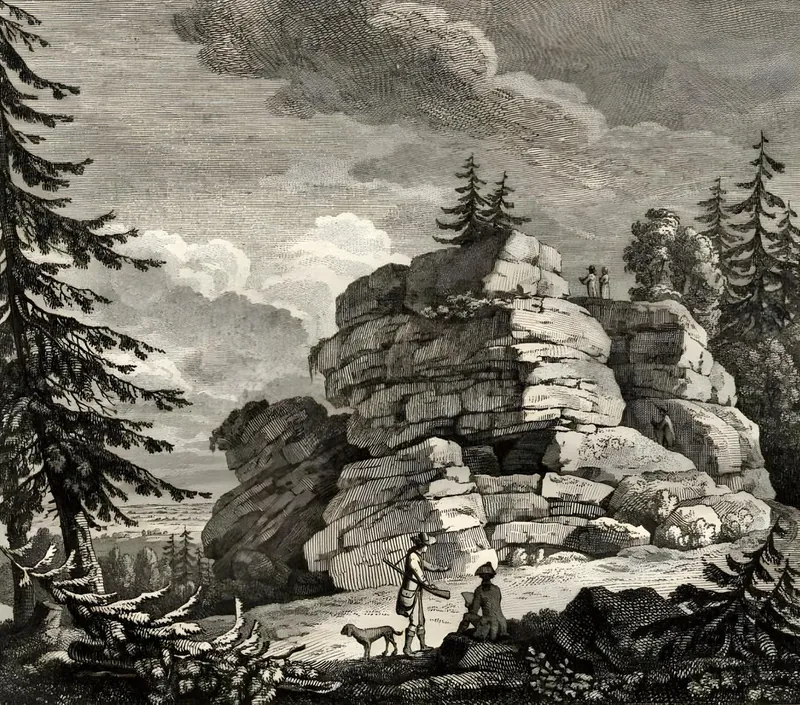
Coins, antiquities and a sphinx with the family arms
Schachmann collected, and he did so methodically: his coin catalogue appeared in 1774. To this he added Egyptian antiquities – a rarity in eighteenth-century Upper Lusatia. That made the manor house a place people came to in order to look and to ask.
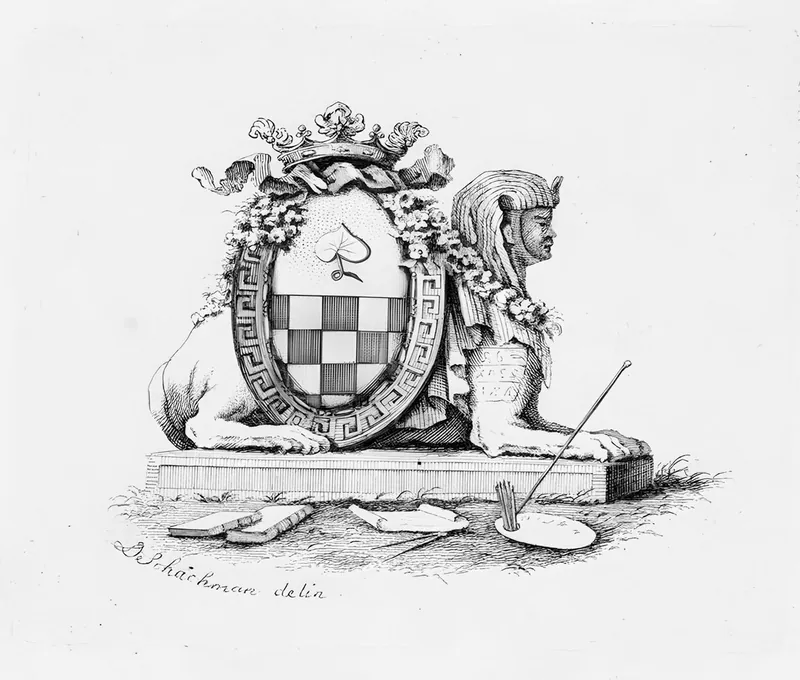
Egypt turns up again in his drawings: the temple of Luxor, and a sphinx. On this sheet she holds the family coat of arms – a chessboard on the shield, in keeping with the name. At lower left is his signature: “Schachman delin.”, drawn by Schachmann himself.
Three of his subjects are within walking distance
The Hochstein, Kuckuckstein and Totenstein lie close together and can be linked in a single walk. The Kuckuckstein stands around 400 metres north of the inn, and several circular walks lead over from the Totenstein. You will find the manor house down in the village, at the foot of the hill.
The website for his 300th birthday
For his 300th birthday in 2025 a website of its own was created: von-schachmann.de. There you will find his biography, drawings and researches in detail – and a good deal that is not to be had here: the Kuckuckstein as a walk-in observatory with the course of day and night, the Opfertisch (Sacrificial Table) as a model at a scale of one to one, the Schachmannsäule (Schachmann Column) reconstructed as it was before it fell into decay. Everything runs in the browser; nothing needs to be installed.
- Biography and timeline
- Drawings and prints
- Research on the Totenstein and Kuckuckstein
- XR: observatory, Opfertisch, Schachmannsäule
- Walking map of the subjects
Stop for a meal where he drew
After the round by way of the Kuckuckstein and Totenstein, the inn stands on the same rock as in 1780. The kitchen cooks everything fresh, and the tower is free.